

Watch: B2B Buyer Accounts
Learn how to manage B2B buyer accounts, including creation, approval, and configuration
Watch: B2B Buyer Accounts
Learn how to manage B2B buyer accounts, including creation, approval, and configuration
Buyers and Sellers
The merchant (called the “seller”) can create a B2B account for each of the companies they sell to. Each B2B account has its own set of users (“buyers”) with the ability to log into the storefront and access B2B-specific pricing and features. Buyers can act on behalf of the account, depending on their permission level. Sellers can assign their own users as sales representatives for these B2B accounts. Sales representatives log in through the Kibo Admin interface and negotiate with their buyers on behalf of the seller. This is a default user role that comes with the platform. See the Users and Role Settings guide for more information and the associated behaviors.Buyer Permissions
There are three types of roles that a B2B buyer can have: an administrator, a purchaser, or a non-purchaser.- The Administrator has all edit, update, and add rights to manage the B2B account. They can view the B2B account hierarchy and manage all child accounts, assign roles, manage custom account attributes, manage the saved payment information and shipping addresses, manage all product lists and quotes, view the transaction history of all purchasers, view the account’s purchase order credit limit and balance, as well as create orders and initiate returns themselves.
- The Purchaser has limited permissions allowing them to submit orders and manage product lists (create, copy, delete, and edit) and quotes (adding and removing items, shipping options, comments, and checking out the quote as an order) as well as their own user information. They can select and edit shipping and payment options during order checkout, initiate returns, and view the account’s purchase order balance, audit history, and account hierarchy. When placing orders, they must use one of the shipping addresses set for the account by the administrator.
- The Non-Purchaser has further limited permissions, only enabling them to manage lists and quotes and to view the account hierarchy. Non-Purchaser users may create and add items to carts, lists, and quotes, but they are not provided the option to proceed to checkout, as they cannot make purchases.
Custom Roles
In addition to system roles, users can create custom roles with specific permission combinations tailored to your organization’s needs. Custom roles enable you to define granular permission sets across 11 different categories, control role availability across parent and child accounts in your account hierarchy, and assign multiple roles to a single buyer for flexible permission combinations. Custom roles can be created, viewed, edited, copied, and deleted based on the behaviors assigned.Creating a Custom Role
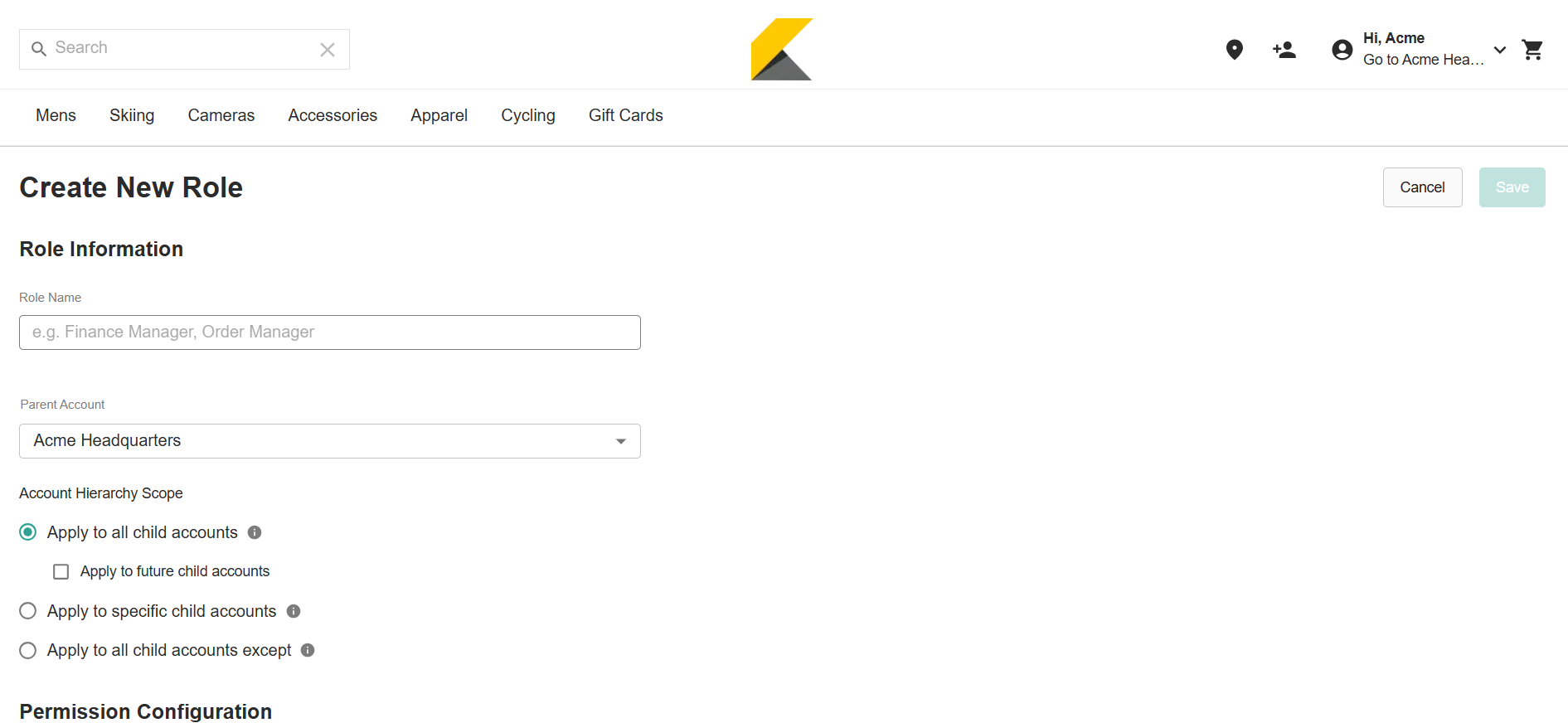
Creating a custom role involves - providing role name, selecting accounts (parent & child) that the role applies to and selecting specific behaviors to define permissions. Users with appropriate permissions can create custom roles on the storefront. To create a custom role:- Define a role name
-
Configure which accounts in the hierarchy can use the role (parent and child accounts): When creating a custom role, from the account hierarchy, select the accounts the role should apply to. This gives you precise control over where each custom role can be assigned within your organization structure. The three account scope options are:
- Apply to all child accounts - Role is created on the parent account and all current and future child accounts (if configured)
- Apply to specific specific child accounts - Role is created on the parent account and any child accounts selected if selected
- Apply to all child accounts except - Role is created on the parent account and to the child accounts except those specifically excluded
-
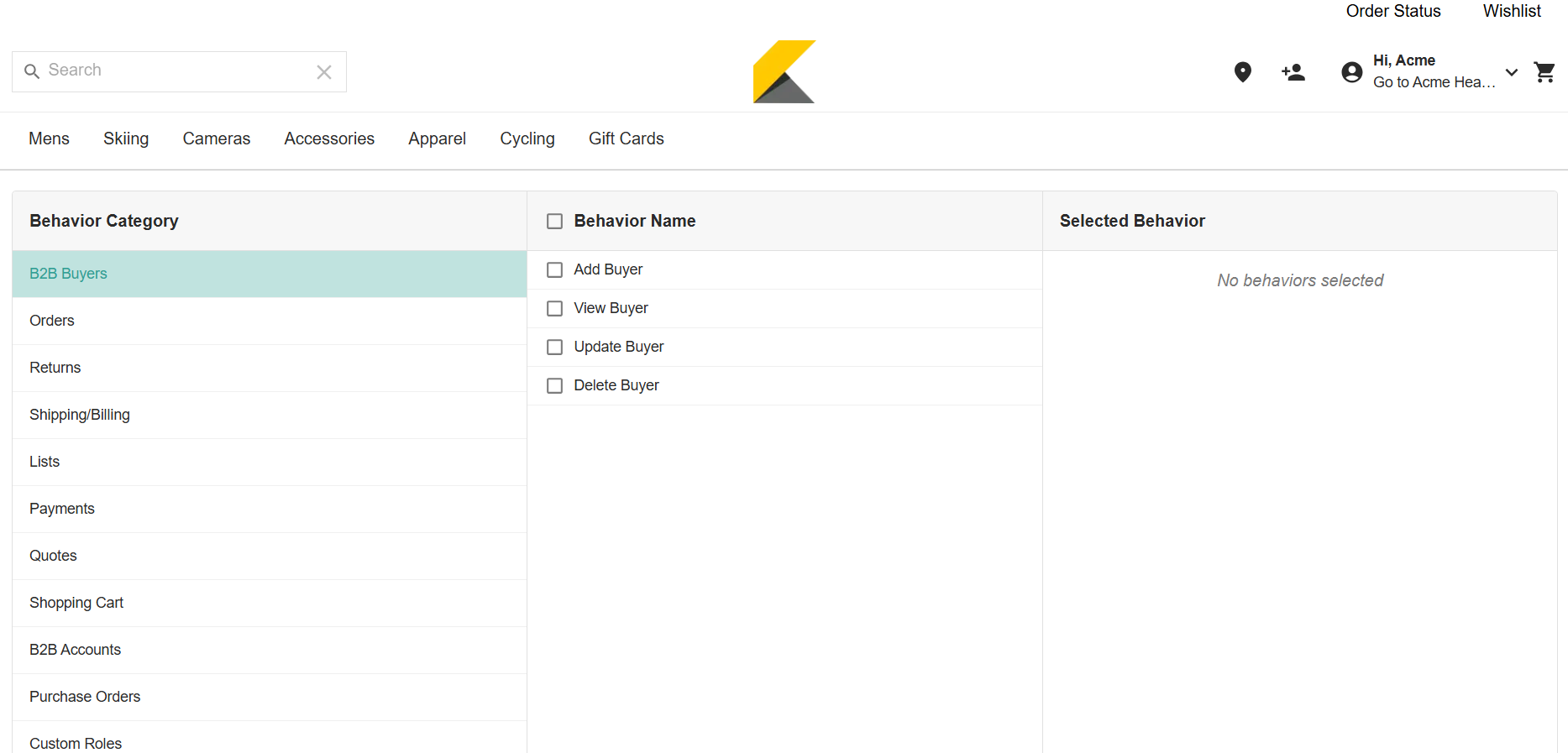
Select specific behaviors from the 11 permission categories :
- Custom Roles - Control who can can create, view, update, and delete custom roles on an account. This category includes four behaviors:
- Create Role - Enables users to create new custom roles
- View Role - Enables users to view custom role
- Update Role - Enables users to edit existing custom roles
- Delete Role - Enables users to delete custom roles
- B2B Buyers - Manage buyers across single or multiple accounts in the account hierarchy. This category includes four behaviors:
- Add Buyer - Enables users to add new buyers to accounts with role assignments, including the ability to add buyers to multiple accounts in a single workflow for accounts within the same hierarchy
- View Buyer - Enables users to view buyer details including their assigned roles and account associations
- Update Buyer - Enables users to modify buyer information and role assignments, including adding or removing roles across multiple accounts
- Delete Buyer - Enables users to remove buyers from accounts
- Orders - Controls order related actions. This category includes two behaviors:
- Create or Update Order - Enables users users to create or update orders and manage subscriptions
- View Order - Enables users to view order history, order details, and subscription information
- Returns - Manage return capabilities including creating and updating returns and viewing return history. This category includes two behaviors:
- Create or Update Return - Enables users to initiate return requests and update return information
- View Return - Enables users to view return details and return history
- Shipping/Billing - Control contact management for shipping addresses and billing information on the account. This category includes three behaviors:
- Create or Update Contact - Enables users to add new shipping addresses and billing contacts or modify existing contact information
- View Contact - Enables users to view saved shipping addresses and billing contact information
- Delete Contact - Enables users to remove shipping addresses and billing contacts from the account
- Lists - Manage product lists including creating and updating lists, viewing list details and contents, and deleting lists. This category includes three behaviors:
- Create or Update List - Enables users to create new product lists and modify existing lists including adding or removing items
- View List - Enables users to view list details and list contents
- Delete List - Enables users to remove product lists from the account
- Payments - Control payment method management for all payment types except purchase orders. This category includes three behaviors:
- Create or Update Payment - Enables users to save new payment methods to the account and modify existing saved payment information
- View Payment - Enables users to view saved payment methods on the account
- Delete Payment - Enables users to remove saved payment methods from the account
- Quotes - Manage quote capabilities. This category includes four behaviors:
- Create Quote - Enables users to create new quotes
- Update Quote - Enables users to modify existing quotes
- View Quote - Enables users to view quote details and quote history
- Delete Quote - Enables users to remove quotes from the account
- Shopping Cart - Control cart management capabilities. This category includes one behavior:
- Manage Cart - Enables users to add items to cart, update quantities, remove items, and manage all other activities related to cart
- B2B Accounts - Control account management actions. This category includes one behavior:
- Update Account Info, Hierarchy and Attribute - Enables users to update account information such as email and account name, manage account hierarchy relationships between parent and child accounts, and update custom account attributes
- Purchase Orders - Control viewing purchase order details and transaction history. This category includes one behavior:
-
View Purchase Order - Enables users to view purchase order details and transaction history, and monitor purchase order usage 11 permissions
-
View Purchase Order - Enables users to view purchase order details and transaction history, and monitor purchase order usage 11 permissions
- Custom Roles - Control who can can create, view, update, and delete custom roles on an account. This category includes four behaviors:
Viewing a Role
Users with appropriate permissions can view all roles available on their account, including both system roles and custom roles. Viewing role details shows which behaviors the role includes and which accounts in the hierarchy can use it.Editing a Custom Role
Users with appropriate permissions on all accounts where a role applies can edit custom roles. Changes to a role affect all users who have been assigned that role across all accounts where it applies. When editing a role, users can:- Update the role name
- Modify which behaviors are included in the role
Copying a Custom Role
Users with the appropriate permissions can copy an existing role as a starting point for creating a new role. The copy operation duplicates the behaviors, allowing users to modify them as needed and save as a new role with a different name.Deleting a Custom Role
Users with appropriate permissions to delete the role on all accounts where the role applies can delete custom roles that are not assigned to any users. When deleted, the role is permanently removed from all accounts where it was configured to apply.Add Buyers to an Account
Buyers can be added to multiple B2B accounts with multiple roles. The buyer can be assigned different roles in different accounts. Users with appropriate permissions can add buyers and assign a role. When adding a buyer:- Enter the buyer’s information.
-
Assign roles:
- If the account belongs to a hierarchy, the interface displays accounts within that hierarchy where the user has permission to add buyers.
- Buyer can be assigned a different role per account.
- Buyers can be assigned multiple roles per account, combining system roles and custom roles as needed
-
The buyer will be created with access to all accounts where roles were assigned.
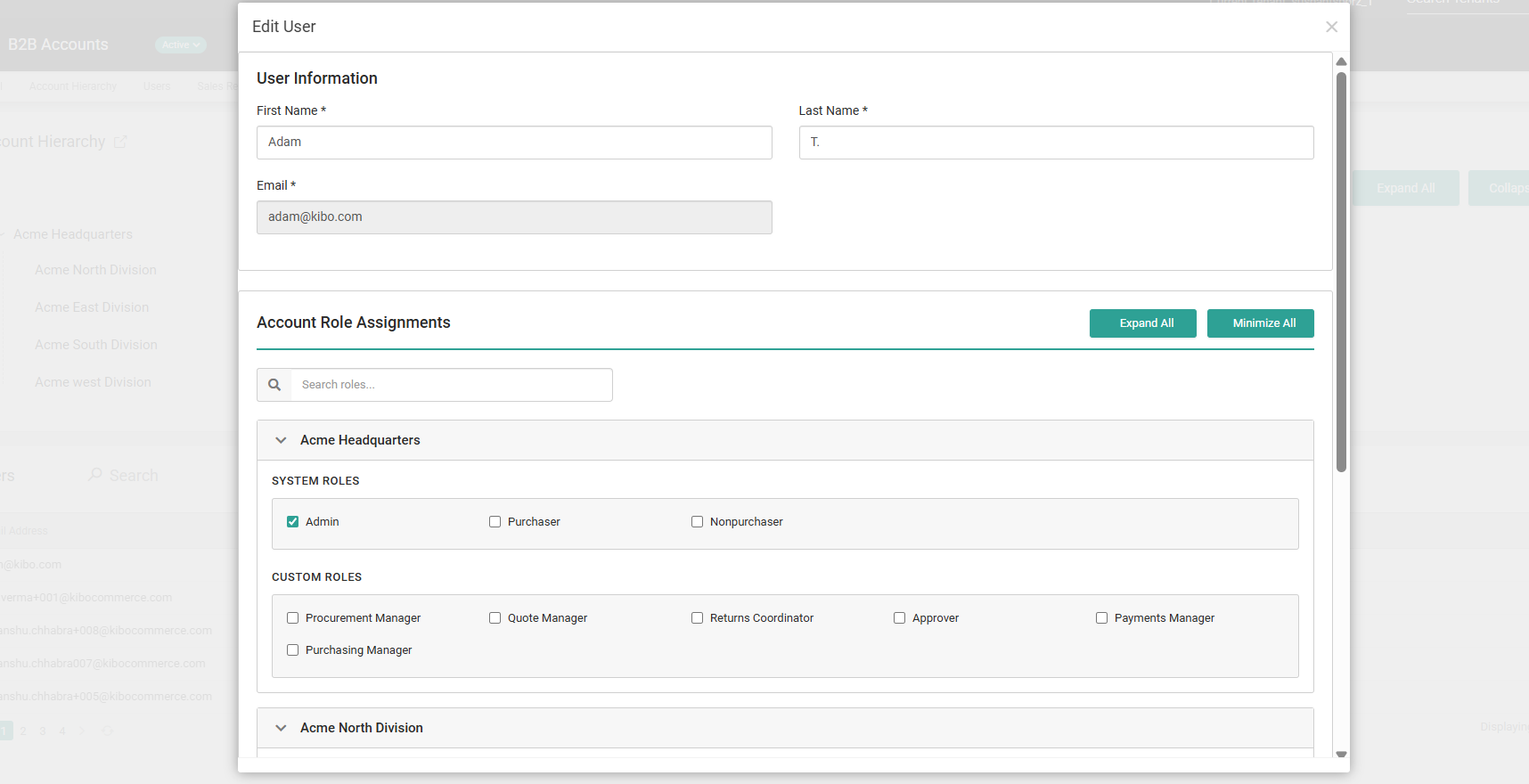
Buyers can also be added to accounts in admin UI.
 The user will receive a B2B welcome email if enabled in your email settings. You can customize this template if needed, such as to display the specific account details.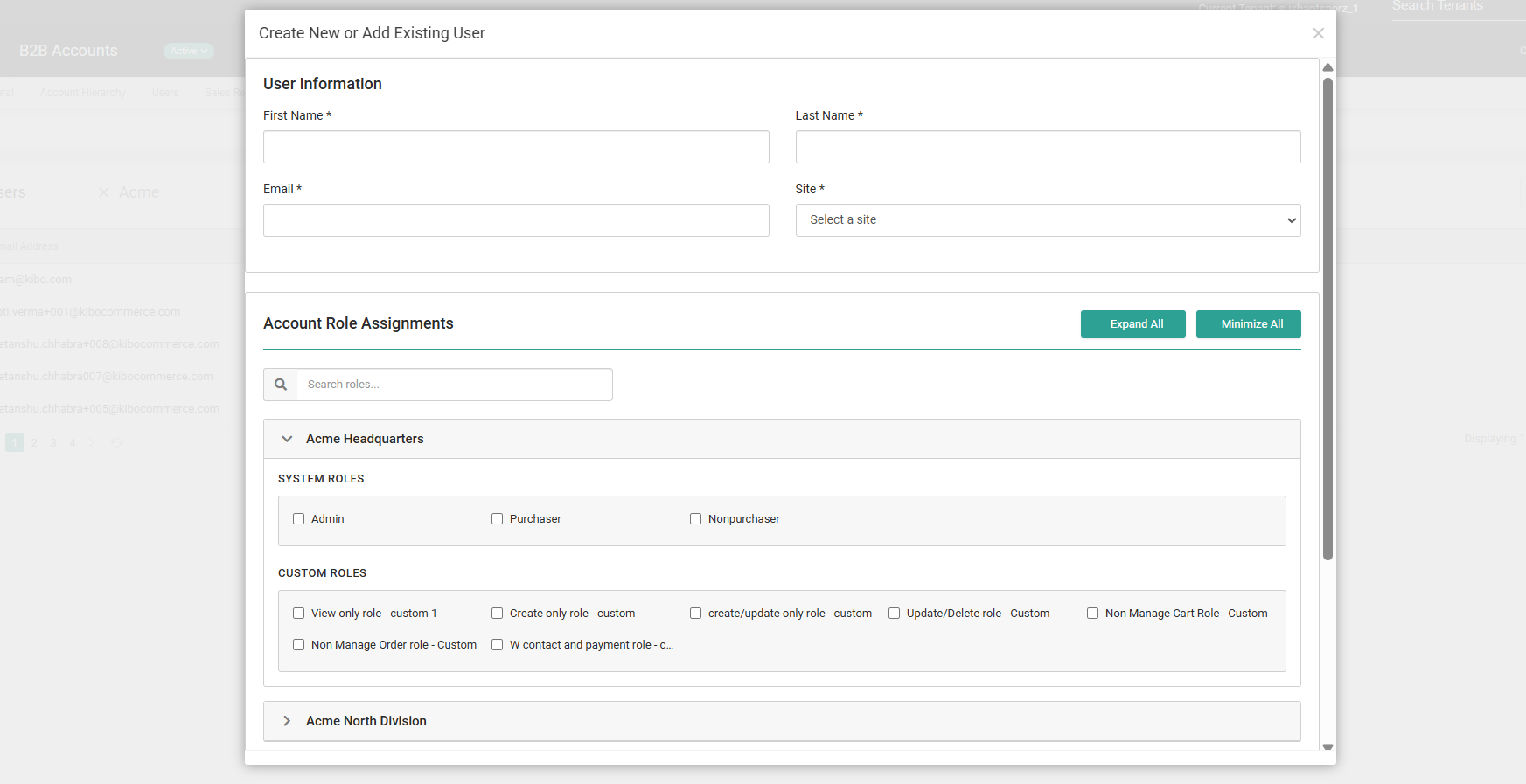
Edit Existing Buyers
Editing Buyer Role Assignments
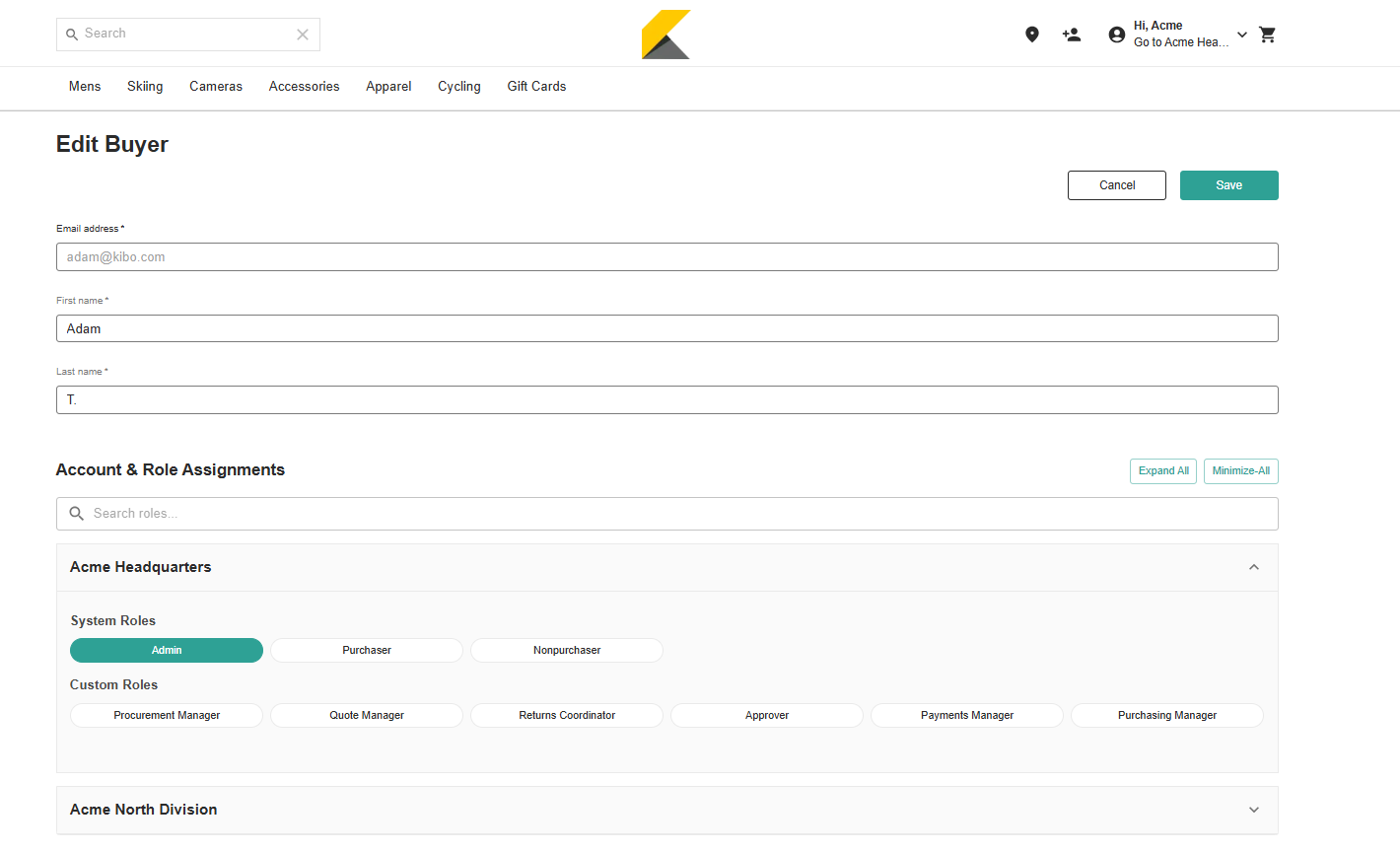
Users with appropriate permissions can modify buyer role assignments within the hierarchy. When editing a buyer:- The interface displays the buyer’s current information and role assignments.
- Users can update the role assignment by either removing an existing role or assigning a new role on an account.
-
Save the changes.
Account Selection
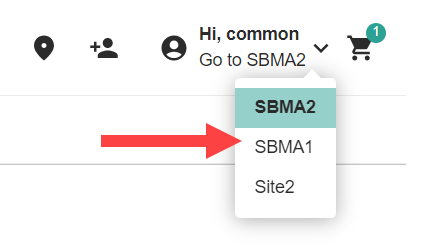
If a buyer has been added to multiple accounts, they can select which one they want to access while logging in to a storefront. This is an example on a headless storefront: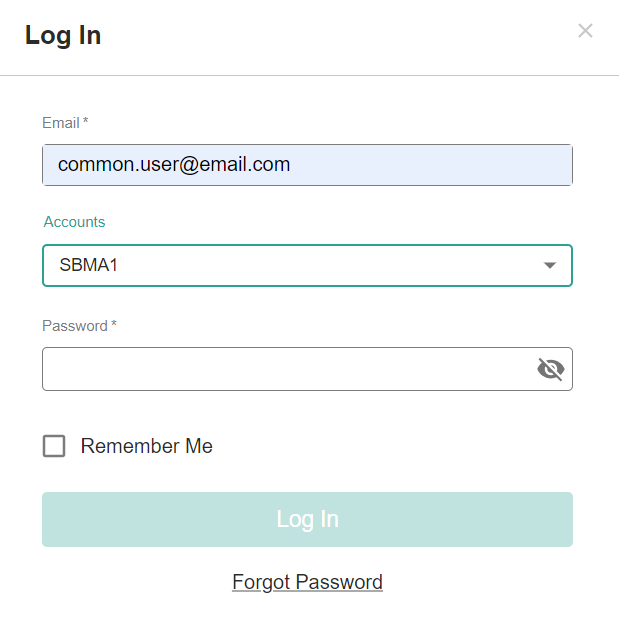
Sales Representatives
A sales representative is an administrative user that can manage customer accounts and quotes. While they have view-only access to price lists, orders, and wish lists, they can create and process quotes to negotiate order pricing with their buyers. A sales representative can access all B2B accounts, but they can only manage quotes for the account(s) they are assigned to. A B2B account must always have at least one sales representative assigned to it, which must be selected upon approval of the account.Manage Sales Reps
Sales representatives are required for all new B2B accounts. However, any existing B2B accounts that were created on production environments prior to the release of the sales representative feature will continue to function as-is without requiring a sales representative. To view and edit sales representatives:- Go to Main > B2B > B2B Accounts.
- Click the account you want to edit.
-
View the list of current sales reps in the Sales Reps section of account details.
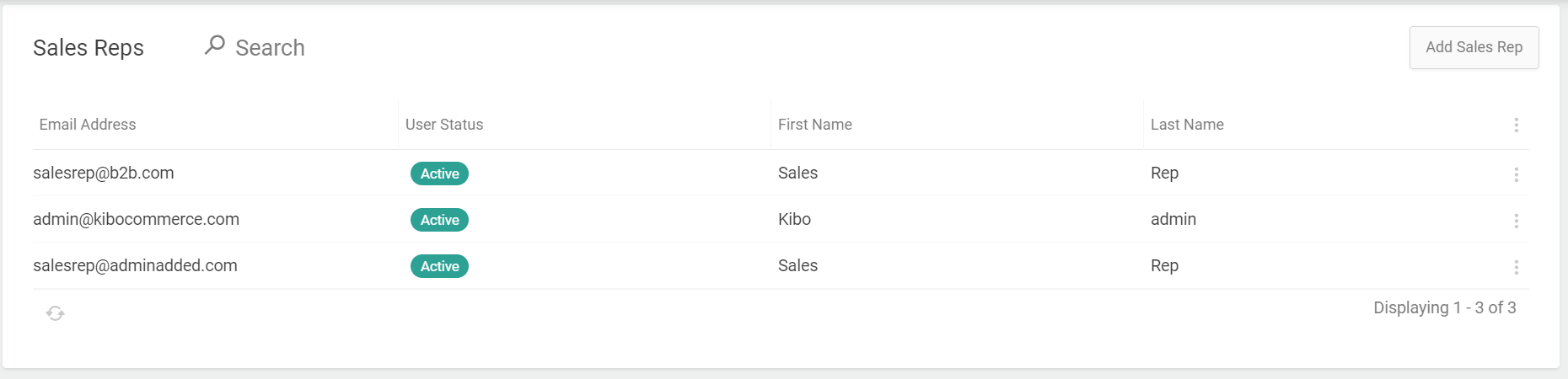
- Click Add Sales Rep in the top right to add another representative.
-
A modal will prompt you to enter an email address.
- The address must be connected to an existing user in the Kibo Admin interface for this to be successful.
-
You can continue to enter additional email addresses.
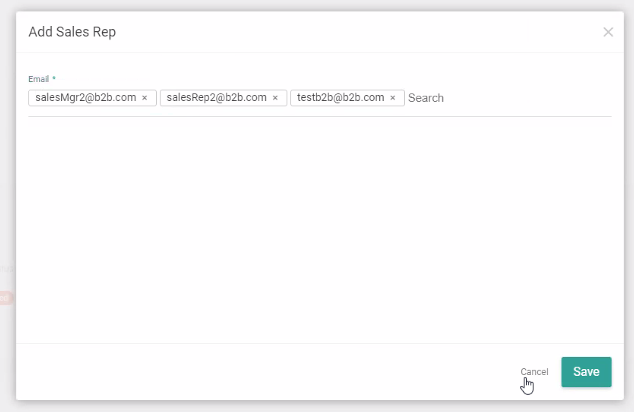
- Click Save. Your additions will now be displayed in the Sales Reps list of the account details.
- You can remove any sales representatives from the list by expanding the drop-down menu on the far right and clicking Remove Sales Rep.