
Note: There is no default Steal-From Rule. If no Steal-From Rules are configured or enabled, no stealing can occur. All short Call-Off Orders that cannot be refilled from free supply fall through to the regular Reservations Job.
Prerequisites
Before configuring Steal-From Rules, ensure the following:- The B2B Wholesale OMS feature is enabled for your tenant. Contact Kibo Support to enable this capability.
- The Reservation Rebalancer is enabled within the Inventory Balancing & Reservations B2B settings under general settings.
- You have Admin or Super Admin role permissions, or a role with the following behaviors assigned:
- Product Rule: Read, Create, Update, Delete
- Customer Rule: Read, Create, Update, Delete
- Steal-From Rule: Read, Create, Update, Delete
How Steal-From Rules Work
Rule Evaluation
All enabled Steal-From Rules run together when the Reservation Rebalancer enters the steal phase. The full set of non-short Call-Off Orders with active reservations is evaluated against each Steal-From Rule in ascending rank order — Rank 1 is evaluated first. When a Call-Off Order matches a rule’s criteria, that rule designates it as a Giver and assigns it a draw order. A Call-Off Order is only matched once — once it qualifies under a rule, it is not re-evaluated against subsequent rules. Call-Off Orders that do not match any enabled Steal-From Rule cannot be Givers and their reserved supply is protected.Seeker vs. Giver Partition
At the start of the steal phase, the engine determines a fixed partition of all relevant Call-Off Orders into potential Seekers and potential Givers. A Call-Off Order is either a Seeker or a Giver in a given run — never both. If a Call-Off Order matches both a Steal-For Rule and a Steal-From Rule, it is treated as a Seeker only and removed from the Giver pool.Giver Draw Order
The Rank on a Steal-From Rule determines the order in which Givers are drawn from. Givers matched by Rank 1 are drawn from first when Seekers need supply. Givers matched by Rank 2 are only drawn from after Rank 1 Givers are exhausted. The sort configured on each rule determines the order within a rank tier — for example, draw from the latest ship date first to protect near-term commitments for as long as possible.A Giver Remains in the Pool
A Giver is not removed from the pool after being partially used. Its remaining reserved supply stays available to later Seekers in the same steal pass. A Giver that goes entirely short after giving up supply to multiple Seekers is not re-promoted to a Seeker in the same run — it falls through to the regular Reservations Job.Criteria Matching
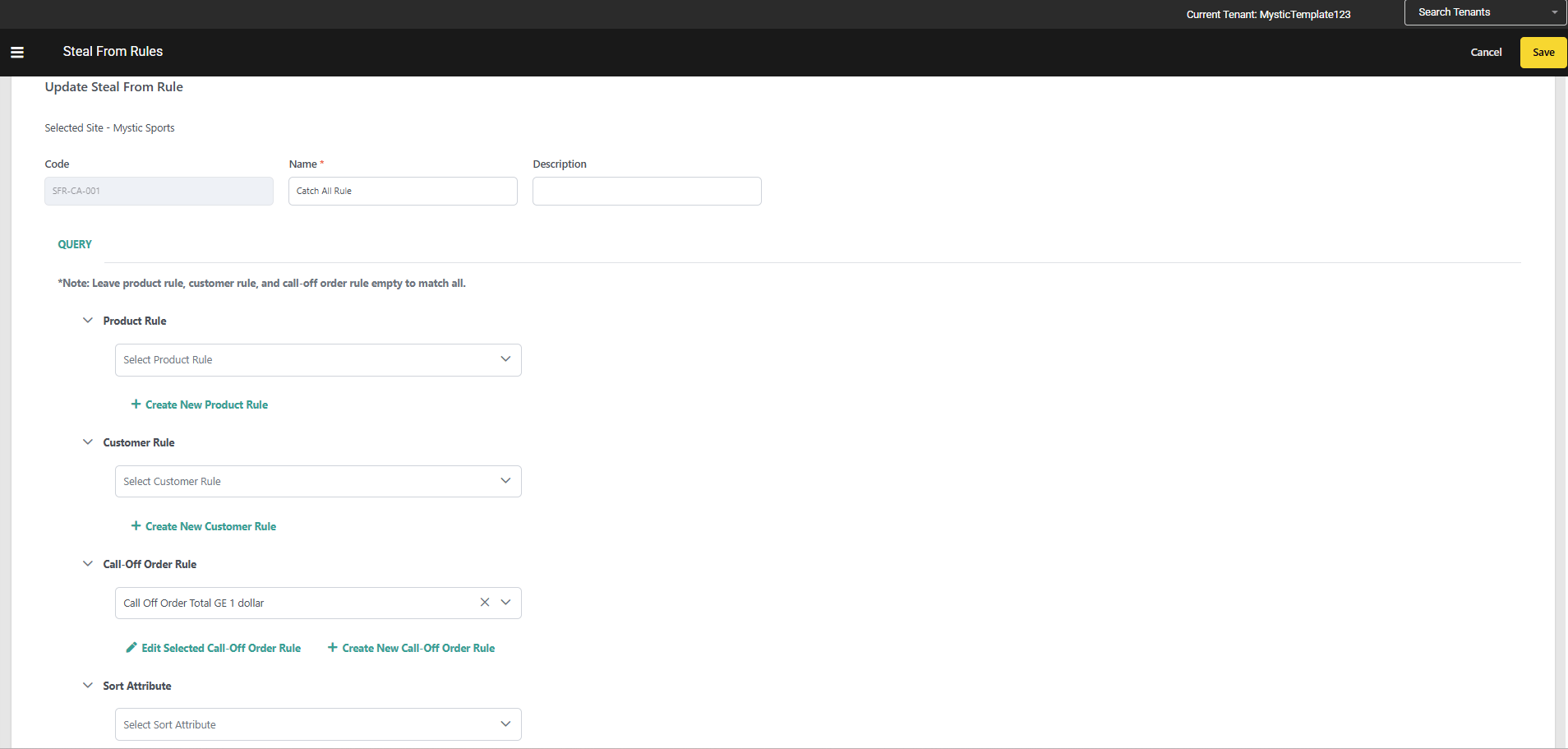
A Call-Off Order must satisfy all defined criteria types on a rule (AND logic across types) to match. Within a single criteria type, conditions can be combined using AND or OR logic in the expression editor. If a rule defines a simple criteria for a particular type which will match all the call off orders (e.g Total Amount ≥ 1$), all orders automatically pass that criterion. This makes it straightforward to configure a catch-all rule at the lowest rank to ensure every Call-Off Order receives an allocation pass.The Ship Date Buffer
Regardless of whether a Call-Off Order is matched by a Steal-From Rule, the Ship Date buffer still applies. The engine will only take supply from a Giver if its ship date is strictly later than the Seeker’s ship date by at least the configured Ship-Date Buffer days. No rule configuration can override or loosen the Date Gate.Important: A Call-Off Order can be designated as an eligible Giver by your Steal-From Rules, but still be protected from a specific steal attempt by the Ship Date buffer. Eligibility under Steal-From Rules is necessary but not sufficient — the Date Gate is always enforced by the engine.
Rule Criteria
A Steal-From Rule supports up to three criteria types:Note: Product Rules , Customer Rules and Call off order Rules created for Steal-For Rules are exclusive to Steal-For Rules and cannot be shared with other rule types.
Rule Attributes
Note: At least one Rule Criteria is needed for the rule to be saved
Configure Steal-From Rules
To create a new Steal-From Rule:- Go to Main > Supply > Rules > Steal-From Rules.
- Select a Site from the site selector.
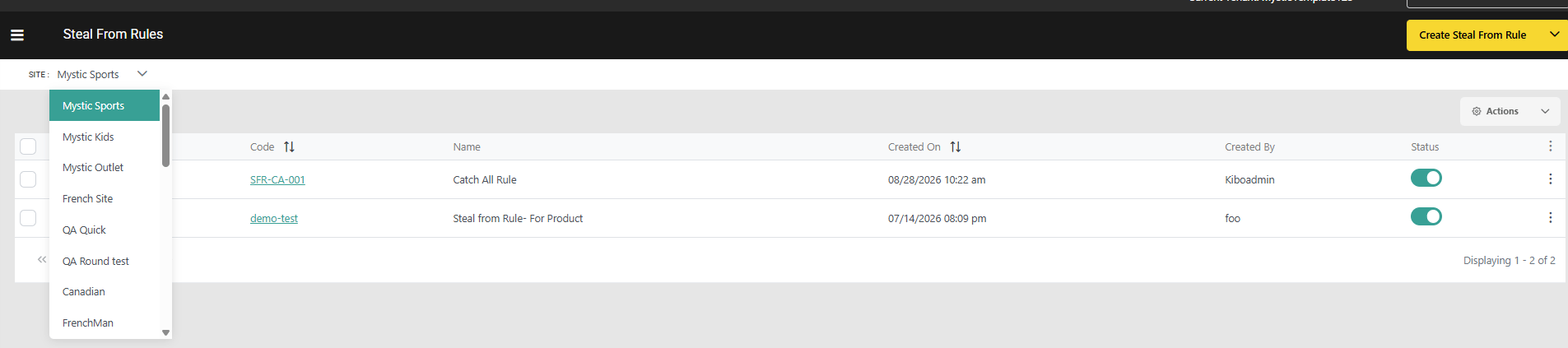
- Click Create Steal-From Rule.
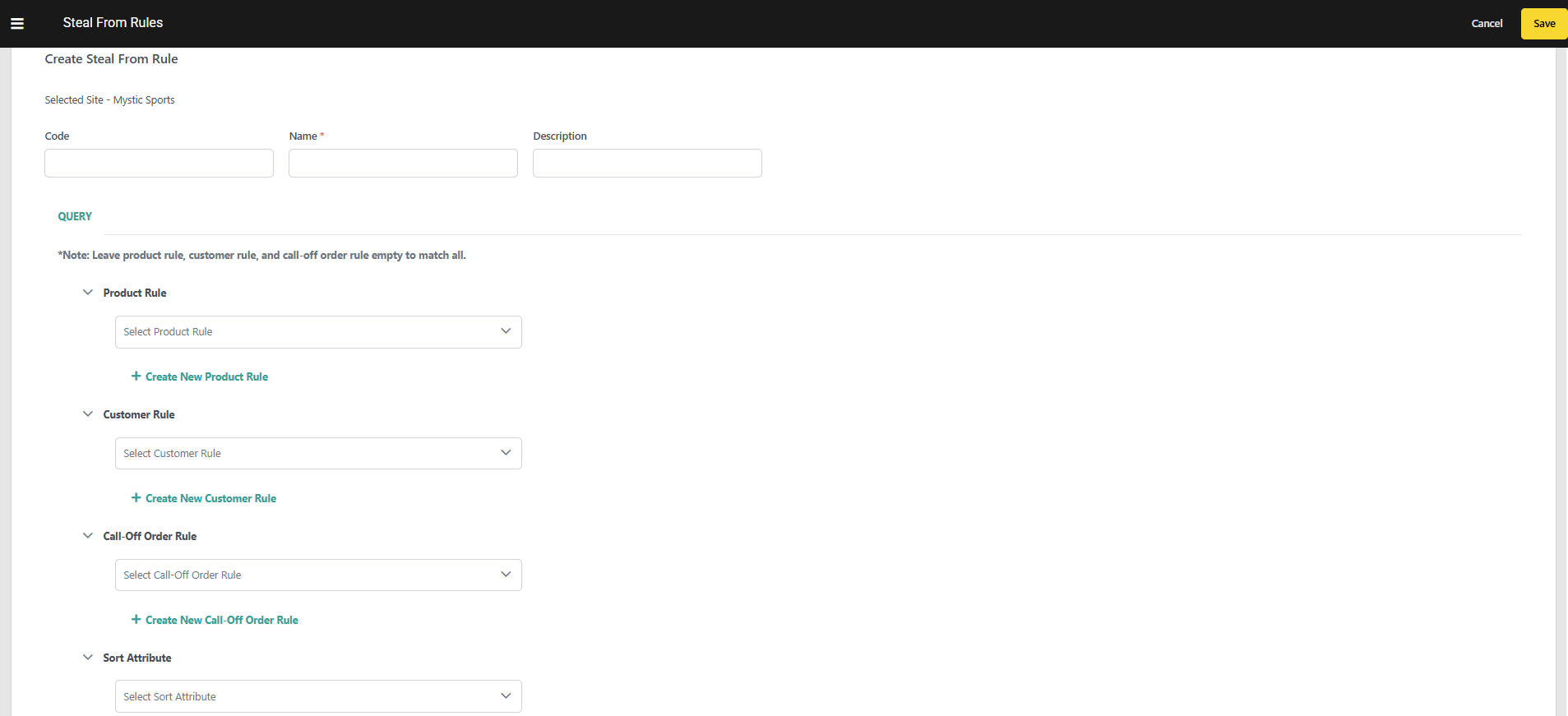
- Enter a Code. If left blank, the system generates one automatically.
- Enter a Name and an optional Description.
- Enter a Rank value. The lower the number, the higher the draw priority — Givers matched by this rule are drawn from before those matched by higher-ranked rules.
- Toggle the rule Enabled to activate it.
- Configure Sort Criteria:
- Under Primary Sort, select a numeric or date field (for example,
requestedShipDate) and choose Ascending or Descending.
- Under Primary Sort, select a numeric or date field (for example,
- Optionally, add Account / Customer Criteria:
- Click Add Customer Rule and use the expression editor to define account-level conditions.
- Optionally, add Product Criteria:
- Click Add Product Rule and use the expression editor to define product-level conditions.
- Optionally, add Call-Off Order Criteria:
- Click Add Call-Off Order Rule and use the expression editor to define order-level conditions.
- Click Save.
Manage Steal-From Rules
Access the Steal-From Rules dashboard at Main > Supply > Rules > Steal-From Rules to manage your configured rules:- Toggle the Status icon on a rule to activate or deactivate it without deleting it. Disabled rules are skipped during batch processing.
- Click on the Kebab icon on a rule to Edit or Delete it.
- Check multiple rules and then use the Actions menu in the top right to enable, disable, or delete them in bulk.
- Edit the Rank of a rule directly in the table, or click and drag to reorder. Rules are always evaluated from highest to lowest rank, with Rank 1 running first.