

Blanket Order → Call-Off Order → Reservation → Sales Order (commitment ledger) → (draw-down request) → (soft allocation) → (fulfillment)The Reservation Service creates and manages reservations by working in conjunction with the Reservation Rules Engine. Rules determine which Call-Off Orders are eligible for reservation and in what priority order. Once a Call-Off Order line is matched by a rule, the Reservation Service soft-allocates inventory across one or more warehouse locations by calling Order Routing, constrained to a configurable time window around the line’s requested ship date (see Reservation Rules for time fence details).
Prerequisites
Before working with Reservations, ensure the following are in place:- The B2B Wholesale OMS feature is enabled for your tenant. Contact Kibo Support to enable this capability.
- Supply Demand UI(new Inventory UI) should be enabled for your tenant. Contact Kibo Support to enable this capability.
- At least one Blanket Order exists and is in Open status.
- At least one Call-Off Order has been created against the Blanket Order and is in Hold status.
- At least one Call Off Reservation Rule is configured and enabled. See Reservation Rules for configuration steps.
- The Reservation batch job is enabled in the Orchestrator settings at the site level. See Batch Job Schedule below.
How Reservations Work
Reservation Lifecycle
A Reservation is created and updated by the Reservation Service on each Reservation run. A Call-Off Order Line progresses through the following statuses based on the quantity reserved against the requested quantity:
Lines that are not fully reserved in a given cycle remain in Partially Reserved status and are automatically re-evaluated in the next batch run. Prior allocations are never lost — reservations accumulate incrementally across cycles.
Fill Rate
Each Call-Off Order Line tracks a fill rate, calculated asreservedQty ÷ requestedQty. The fill rate is the shared data point between the Reservation Engine and the Call-Off Release Rules Engine: the Reservation Service writes the fill rate, and the Release Engine reads it to determine when a line is eligible to be converted into a Sales Order.
Note: A reservation never creates a Sales Order. Sales Order creation is handled exclusively by the Call-Off Release Rules Engine
Estimated Delivery Date
Each time the Reservation Service allocates inventory against a Call-Off Order Line, it also calculates an Estimated Delivery Date (EDD) for that line. The EDD is a system-calculated, inventory-backed promise date representing when the reserved goods are expected to reach the buyer — distinct from the buyer’s own Requested Ship Date input, which is used only to anchor the time fence window. EDD is calculated and displayed at the line-item level only. There is no header-level EDD rollup on a Call-Off Order in this release.EDD Statuses
The EDD on a Call-Off Order Line has two internal states:
Example:
A Call-Off Order Line has a requested quantity of 100 units.
- Batch cycle 1 (Aug 1): Reservation Service allocates 20 units → EDD calculated as Aug 5
- Batch cycle 2 (Aug 10): Reservation Service allocates the remaining 80 units → EDD recalculated as Aug 20 (delta > 0, so recalculation triggers)
- Released to Sales Order: EDD locks at Aug 20 and is copied to the Sales Order Line Item
How EDD Is Calculated
When the Reservation Service allocates inventory against a Call-Off Order Line in a batch cycle, it invokes Kibo’s existing EDD Suggestion API for that line using the product code, quantity, fulfillment type, and the line’s ship-to address. The key distinction from standard EDD calculation is how the time fence is applied: When reservation drew from Future Inventory: The EDD API’s future-date reference is set to the lower bound of the line’s time fence window (requestedShipDate − timeFenceDays) rather than the site’s default Future Date Limit. This ensures the EDD search considers only the same inventory window the Reservation Rule was permitted to draw from — not a broader site-wide window — and returns the earliest attainable EDD within that fence. If the time fence overlaps with current on-hand inventory, current inventory is also considered.
When reservation drew from Current Inventory only: The EDD API is called without a future-date override. Standard current-inventory EDD calculation applies.
The resulting EDD reflects the Fulfillment Date at the reserved location plus the configured carrier shipping or delivery transit time for the line’s fulfillment type.
Multi-Location EDD
A single Call-Off Order Line can accumulate reservations across multiple locations over successive batch cycles (see Multi-Location Allocation). When this occurs, the system calculates an EDD for each contributing location separately. The line-level EDD displayed is the latest (maximum) EDD across all contributing locations — consistent with Kibo’s existing pattern for multi-location consolidation, where the latest fulfillment date across contributing sources determines the overall promise date. Example:EDD at Release — Finalization
At the moment a Call-Off Order Line is released and converted into a Sales Order, the most recent Provisional EDD is locked as Final and copied onto the corresponding Sales Order Line Item. This is a one-time, one-directional copy at creation. Kibo’s standard Sales Order and shipment EDD behavior — governs the field from that point forward.Multi-Location Allocation
A single Call-Off Order Line can accumulate reservations across multiple warehouse locations. If Order Routing identifies inventory at multiple locations to satisfy a line’s quantity, the Reservation Service records individual allocations per location. In subsequent cycles, if the same location is recommended, the existing quantity at that location is incremented. If a new location is found, a new allocation entry is added. Example — Partial Reservation across multiple locations:Multi-Ship-To Address Handling
A single Call-Off Order can contain lines destined for multiple ship-to addresses. The Reservation Service groups lines by ship-to address and performs Order Routing separately for each group. Allocations from different locations may be assigned to different lines within the same order.Inventory Segmentation
If a segment tag is specified on a Call-Off Order, the Reservation Service restricts inventory allocation to the designated segment only. Inventory from outside the specified segment is not considered during Order Routing. For more information on inventory segmentation, see Inventory Segmentation.Impact on Available-to-Promise (ATP)
Active Reservations reduce the Available-to-Promise (ATP) quantity for the reserved product and location combinations. Inventory soft-allocated for a B2B Call-Off Order is not available to other order types until the reservation is released or cancelled.Reservation Statuses
Batch Job Schedule
The Reservations Job runs as the final stage of the Orchestrator — the coordinated scheduler configured on the B2B tab under Inventory Balancing & Reservations. On every Orchestrator pass, the enabled jobs run in a fixed order: Allocation Rebalancer → Reservation Rebalancer → Reservations Job. There is no separate schedule for the Reservations Job — its timing is governed by the Orchestrator’s Run Mode and Run Every settings. Each run evaluates all Call-Off Orders in Hold or Partially Reserved status. Lines that are already Fully Reserved are not re-evaluated. To configure the Reservations Job:- Go to Main > System > Settings > Site.
- Select the B2B tab.
- Under Inventory Balancing & Reservations, set Run Mode to Automatic or Manual. If Automatic, enter the Run Every interval — a positive integer greater than 1, in Minutes, Hours, or Days.
- Toggle Reservations Job on to enable this job and reveal its sub-settings (Use Current Inventory and Use Future Inventory Before Current).
- Click Save.
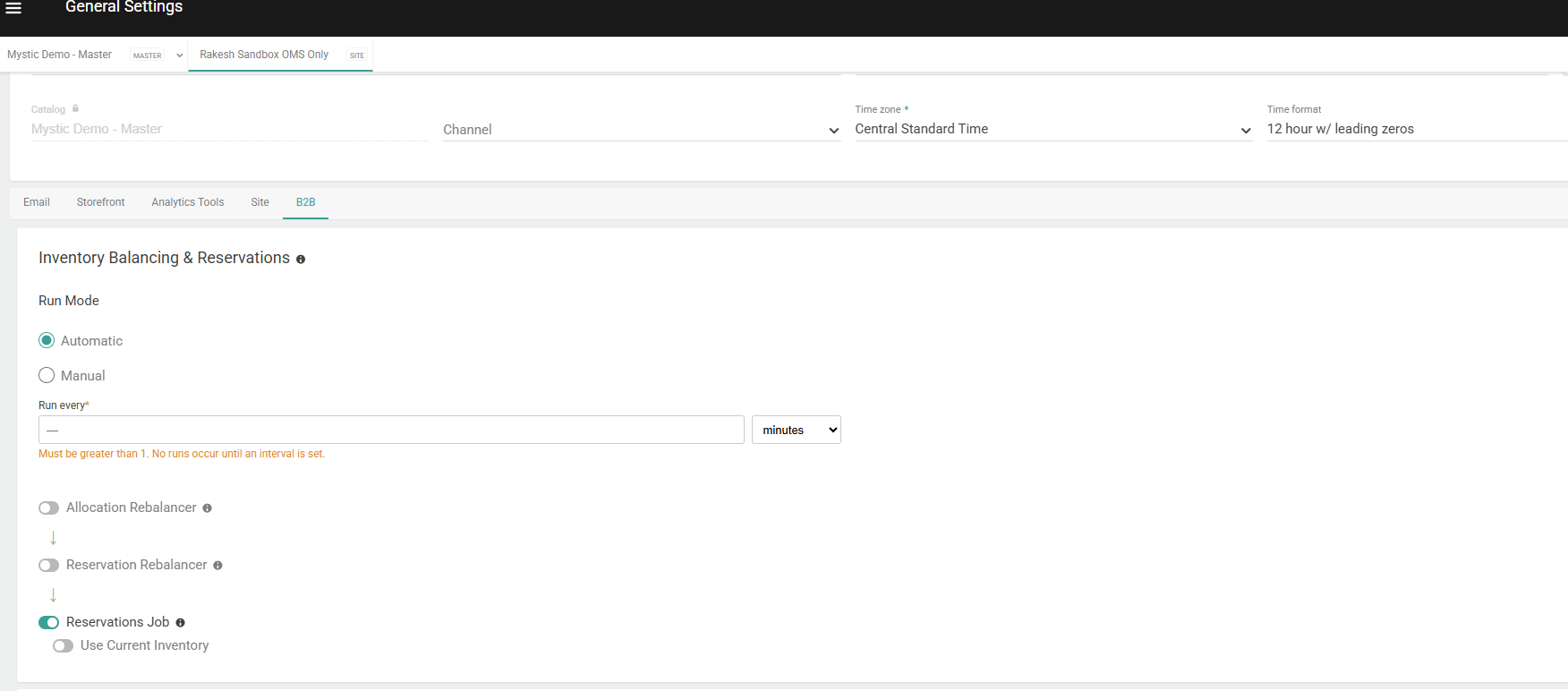
Note: The Reservation job, Reservation Rebalancer, and Allocation Rebalancer are orchestrated together as part of the site-level scheduling configuration. You can enable or disable each component independently. See Inventory Balancing & Reservations Settings for details
On-Demand Run
When the Orchestrator Run Mode is set to Manual, the Reservations Job is triggered on demand via Run Reservation Rule button on Call Off Order Screen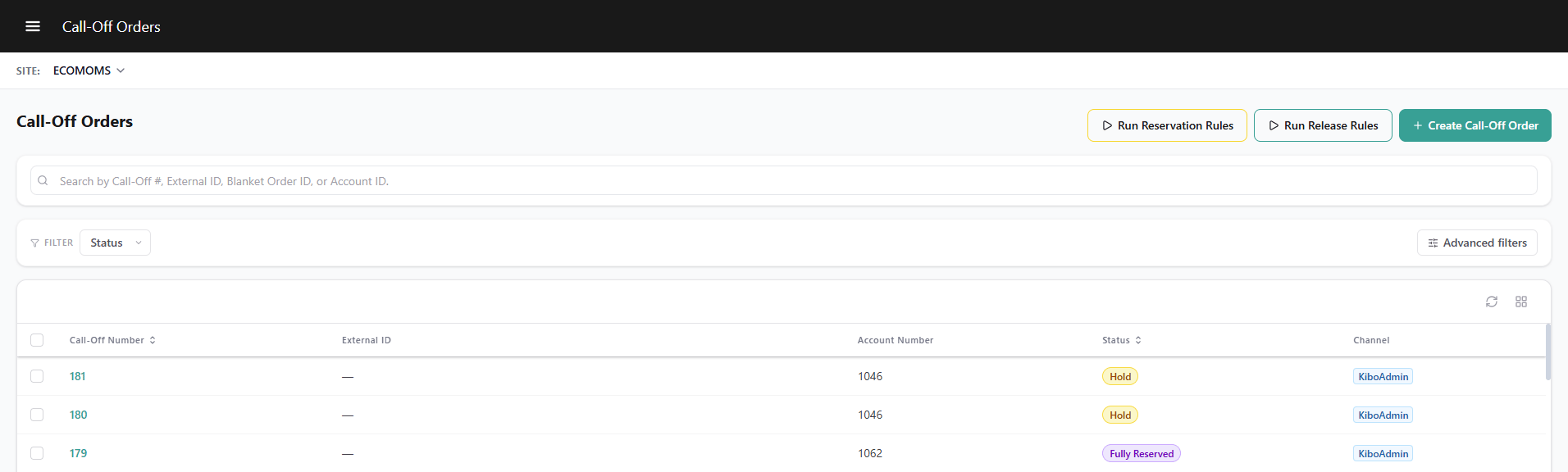
View Reservations
You can view B2B Wholesale OMS reservations associated with a product and location using the Supply & Demand modal in the Inventory UI. The modal provides a consolidated, real-time view of total supply, total demand, and net position for the selected items — and surfaces reservation records in a dedicated tab below the summary tiles. To view reservations for a product and location:- Go to Main > Supply> Inventory > Supply Demand
- Search for the item you want to inspect by entering a Product Code, Product Name, or selecting a Location. Results appear in the inventory grid below the search bar.
- Check the checkbox on the row (or rows) for the item and location combination you want to inspect.
- Click View Supply & Demand. The Supply & Demand modal opens.
- The modal header tiles display:
- Below the summary tiles, select the Reservations tab to view all active B2B Wholesale OMS reservations for the selected item and location.
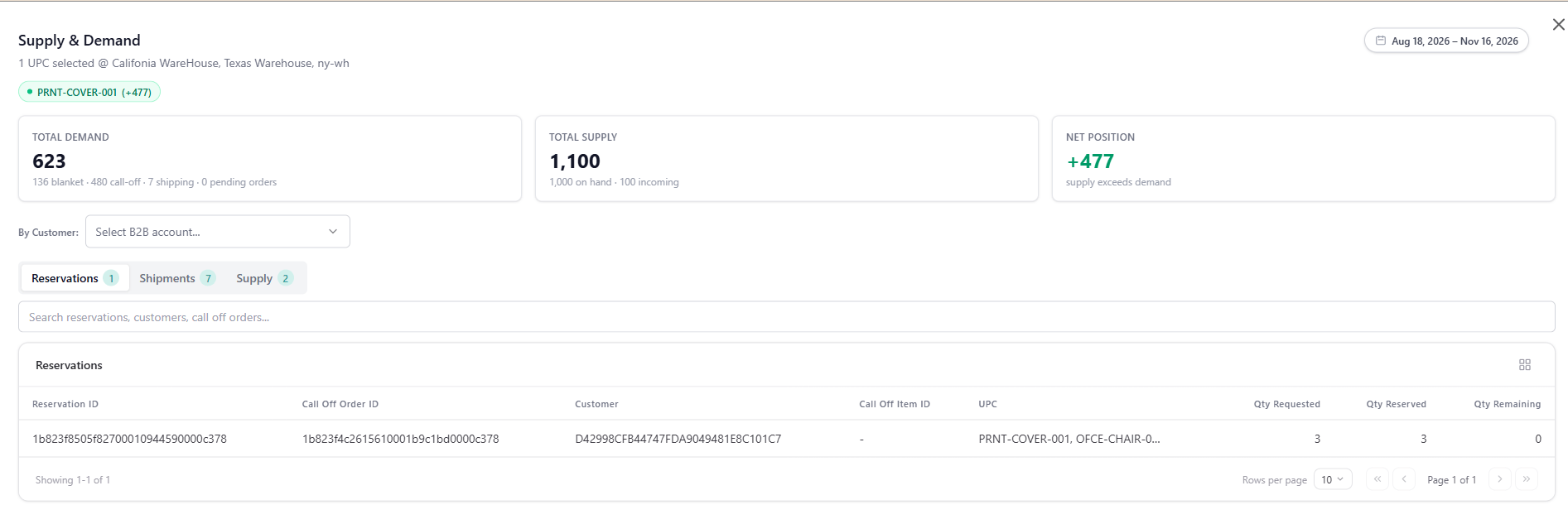
- Optionally, use the B2B Account filter in the modal header to scope the reservation data to a specific buyer account. Without a selection, reservation data across all accounts is shown.
Note: The B2B Account filter inside the modal scopes all demand and reservation data to the selected account. This is useful when you want to inspect how much inventory is reserved against a specific buyer’s Call-Off Orders rather than viewing the aggregate across all accounts.
Fulfillment Types Supported
Reservations support standard Order Routing consolidation logic. No special treatment is required for consolidation scenarios.
Extensibility
The Reservation APIs support API arc actions for extensibility. Clients can subscribe to public events emitted when a reservation is created, updated, or cancelled. Events:- Reservation Created
- Reservation Updated
- Reservation Cancelled