

Prerequisites
Before configuring Future Shipment Rules, ensure the following:- The B2B Wholesale OMS feature is enabled for your tenant. Contact Kibo Support to enable this capability.
- You have Admin or SuperAdmin role permissions, or a role with the following behaviors assigned:
- Product Rule: Read, Create, Update, Delete
- Customer Rule: Read, Create, Update, Delete
- Future Shipment Rule: Read, Create, Update, Delete
How Future Shipment Rules Work
Rule Evaluation
When the Allocation Rebalancer’s rebalancing flow reaches the future shipment prioritization step, all enabled Future Shipment Rules run together against the impacted shipments. Each shipment is evaluated in ascending rank order — Rule 1 runs first, followed by Rule 2, and so on. When a shipment matches a rule’s criteria, that rule assigns a priority rank to the shipment. A shipment is only evaluated once — once it matches a rule, it is not re-evaluated against subsequent rules. Shipments that do not match any enabled rule will be considered by Catch All Rule, which is treated as the lowest possible priority during reallocation.Its up to the Admin to create a Catch All Rule Criteria such that all the shipments get eligible in that rule
Criteria Matching
A shipment must satisfy all defined criteria types on a rule (AND logic across types) to match. Within a single criteria type, conditions can be combined using AND or OR logic as configured in the expression editor.Sort
Each Future Shipment Rule includes a Primary Sort Attribute and an optional Secondary Sort Attribute, each with its own Sort Direction (Ascending or Descending). For Future Shipments that match the same rule, the primary sort determines their relative order within that priority tier. The secondary sort is applied only as a tie-breaker, when two or more matched Future Shipments share the same primary sort value.De-Allocation Order
When supply decreases and not all future shipments can retain their allocation, de-allocation follows reverse priority order — shipments with the lowest priority (highest rank number ) lose their allocation first. This protects higher-priority commitments from losing inventory to lower-priority ones.Rule Criteria
A Future Shipment Rule supports up to three criteria types:Note: Product Rules, Customer Rules and Shipment Rules created for Future Shipment Rules are exclusive to Future Shipment Rules and cannot be shared with other rule types.
Rule Attributes
Configure Future Shipment Rules
To create a new Future Shipment Rule:-
Go to Main > Fulfillment > Rules > Future Shipment Rules.

- Click Create Future Shipment Rule.
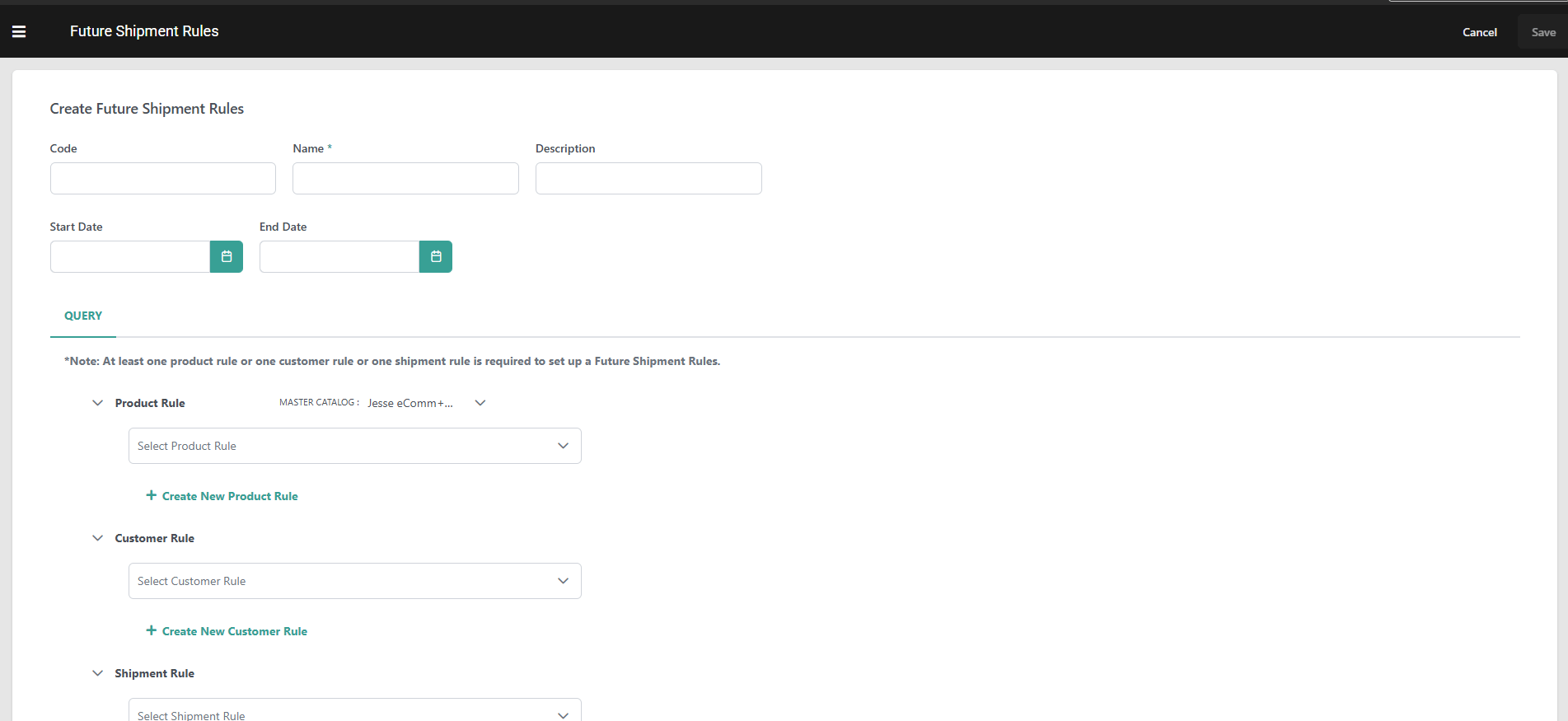
- Enter a Code. If left blank, the system generates one automatically.
- Enter a Name and an optional Description.
-
Use the optional Start Date and End Date fields to schedule when the rule is eligible for evaluation.
- If both fields are blank, the rule is always eligible — the default behavior.
- The rule is only evaluated when it is Enabled and the current date and time falls within the window.
- Enter a Rank value. The lower the number, the higher the priority. Default takes the last rank.
- Enter a Time Fence Days value. The rebalancer searches for alternate inventory within this symmetric window around the shipment’s requested ship date.
-
Toggle the rule Enabled to activate it.
-
Configure Sort Criteria: Under Primary Sort Attribute, select a sort field and choose a Sort Direction of Ascending or Descending.
Optionally, under Secondary Sort Attribute, select a tie-breaker field and its own Sort Direction. The secondary sort is applied only when matched call off orders have the same primary sort value. -
Optionally, add Account / Customer Criteria:
- Click Add Customer Rule and use the expression editor to define account-level conditions.
-
Optionally, add Product Criteria:
- Click Add Product Rule and use the expression editor to define product-level conditions.
-
Optionally, add Shipment Criteria:
- Click Add Shipment Rule and use the expression editor to define shipment-level conditions.
- Click Save.
Note: Only Extensible/Custom attributes marked Available for Rules on their attribute definition appear in this rule’s criteria builders for Product Rules and Shipment Rules(header as well as item level).
Manage Future Shipment Rules
Access the Future Shipment Rules dashboard at Main > Fulfillment > Rules >Future Shipment Rules to manage your configured rules:- Toggle the Status icon on a rule to activate or deactivate it without deleting it.
- Expand the actions menu on a rule to Edit or Delete it.
- Check multiple rules and use the Actions menu to enable, disable, or delete in bulk.
- Edit the Rank of a rule directly in the table, or click and drag to reorder.
- The list displays Start Date and End Date columns. Click either column header to sort the list by that date.
- Use the Search & Filter section to narrow the list by Rule Code, Rule Name, Start Date, End Date, Status (Enabled/Disabled), and Created By.
