

Order Line Item Attributes
Order line item attributes apply independently to each specific line item within the order. For example, a gift message or a handling flag that applies to a specific line item within the order.Subscription Line Item Attributes
Similar to order line item attributes, subscription line item attributes can also be created by selecting Subscription under Apply Attribute To.Shipment Line Item Attributes
Fulfillment users view and populate shipment line item attribute values during the fulfillment workflow. Shipment line item attributes apply independently to each line item within a shipment. For example, Orientation Required, Actual Weight, Pick Zone, or Damage Observed. When both Order and Shipment are selected under Apply Attribute To, the attribute is created for both the order line item and the shipment line item. The Attribute Value Sync Setting determines how the value flows between the order line item and the shipment line item. See the Attribute Value Sync Setting section below for details.Blanket Order Line Item Attributes
Blanket Order line attributes apply custom metadata to individual product lines within a Blanket Order. For example, these attributes enable tracking of customer-specific part numbers, seasonal allocation tags, or negotiated terms per line item.Call Off Order Line Item Attributes
Call-Off Order line attributes apply custom metadata to individual lines within a Call-Off Order. For example, these attributes enable tracking of line-level priority flags or special fulfillment instructions per line item.Attributes Grid
All line item-level attributes are managed at System > Schema > Extensible Item Attributes. You can filter the data grid by entity type — Order, Subscription, or Shipment — and toggle columns on or off using the dropdown on the far right of the data grid headers. To edit an existing attribute or disable one that is currently enabled, click the attribute in the data grid to open its settings.Create a Line Item Attribute
- Go to System > Schema > Extensible Item Attributes.
- Click Create New Attribute.
- In the General section, complete the following:
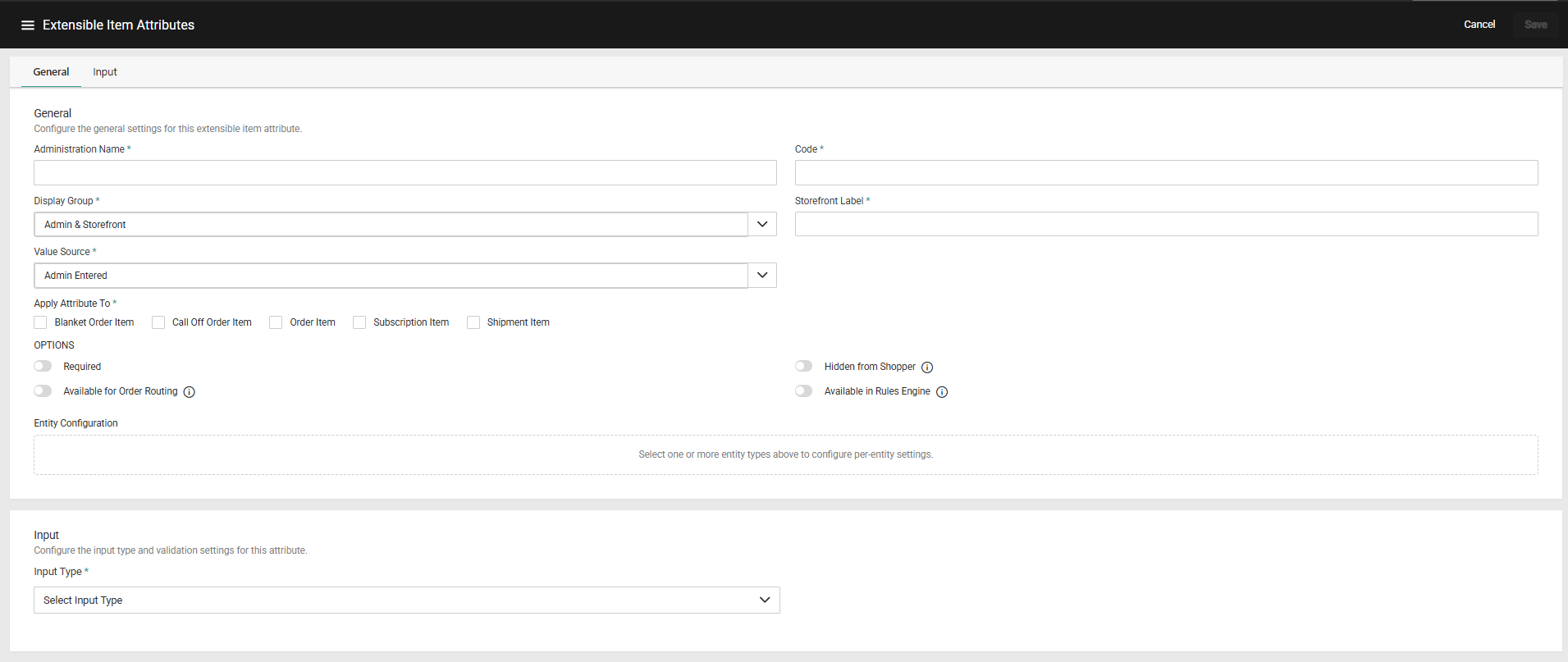
- Enter an Administration Name.
- Enter a Code.
- Use the Display Group drop-down menu to specify one of the following options.
- Admin Only: The attribute only displays in Admin.
If you select this option, you can only select Admin Entered for the Value Source. - Admin & Storefront: The attribute displays both in Admin and on the storefront.
- Admin Only: The attribute only displays in Admin.
- (If applicable) If you selected Admin & Storefront for the Display Group, provide a Storefront Label.
This is the label that shoppers will see for the attribute on the storefront. - Use the Value Source drop-down menu to specify one of the following options.
- Shopper Entered: The shopper can provide a value for the attribute.
- Admin or Shopper Entered: Either the Admin user or shopper can provide a value for the attribute.
- Admin Entered: The Admin user is the only one who can provide a value for the attribute.
- In the Apply Attribute To setting, select one or more entities this attribute applies to — Blanket Order , Call Off Order, Order, Subscription, or Shipment. You can create a line item attribute for a single entity or select multiple entities. This selection cannot be changed after the attribute is saved.
- Select a value under Options.
- Required: If enabled, the attribute requires a value on all order line items before they can be submitted. For shipments, if enabled, the attribute requires a value and the shipment cannot be fulfilled until a value is provided.
- Hidden from shopper: If enabled, the attribute is hidden on the storefront. The attribute can still have a value populated, but it is not displayed to shoppers.
For example, you might want to capture internal handling instructions or operational flags against a line item, but you do not want this information displayed to shoppers. - Available for Rules: If enabled, this attribute can be used as a condition in rule criteria and, for rule types that support sorting, as a sort field. The setting is disabled by default and applies across all rule types.
- In the Input section, use the Input Type drop-down menu to specify the input type for the attribute. You can choose a list, text box, text area, yes/no, or date for the type. Depending on the input type and data type you select, other fields may display that require additional information
- Review the Entity Configuration section, which appears based on your Apply Attribute To selection. See the Entity Configuration section below for details.
- Click Save.
Entity Configuration
After selecting one or more entities under Apply Attribute To, a configuration section appears for each selected entity. The Editable setting is available across all entity types and controls whether a line item attribute value can be modified after it has been initially set. For order line item attributes, the Editable setting allows admin to edit the attribute value post order submit. Similarly, for shipment line item attributes, the Editable setting allows fulfiller user to edit the shipment line item attribute after the shipment has been created.For Blanket Order line attributes, the Editable setting determines whether attribute values can be modified post-creation. Value updates are governed by the line and order lifecycle status, permitting edits depending on the current status of the order line.
For Call-Off Order line attributes, the Editable setting controls whether attribute values can be updated post-creation. Field updates are governed by the line and order lifecycle status, permitting edits depending on the current status of the order line. When both Order and Shipment are selected under Apply Attribute To, an additional setting — Attribute Value Sync Setting — appears within the Shipment section. The Attribute Value Sync Setting determines determines how the value flows from the order line item to the shipment line item. See the Attribute Value Sync Setting section below for details.
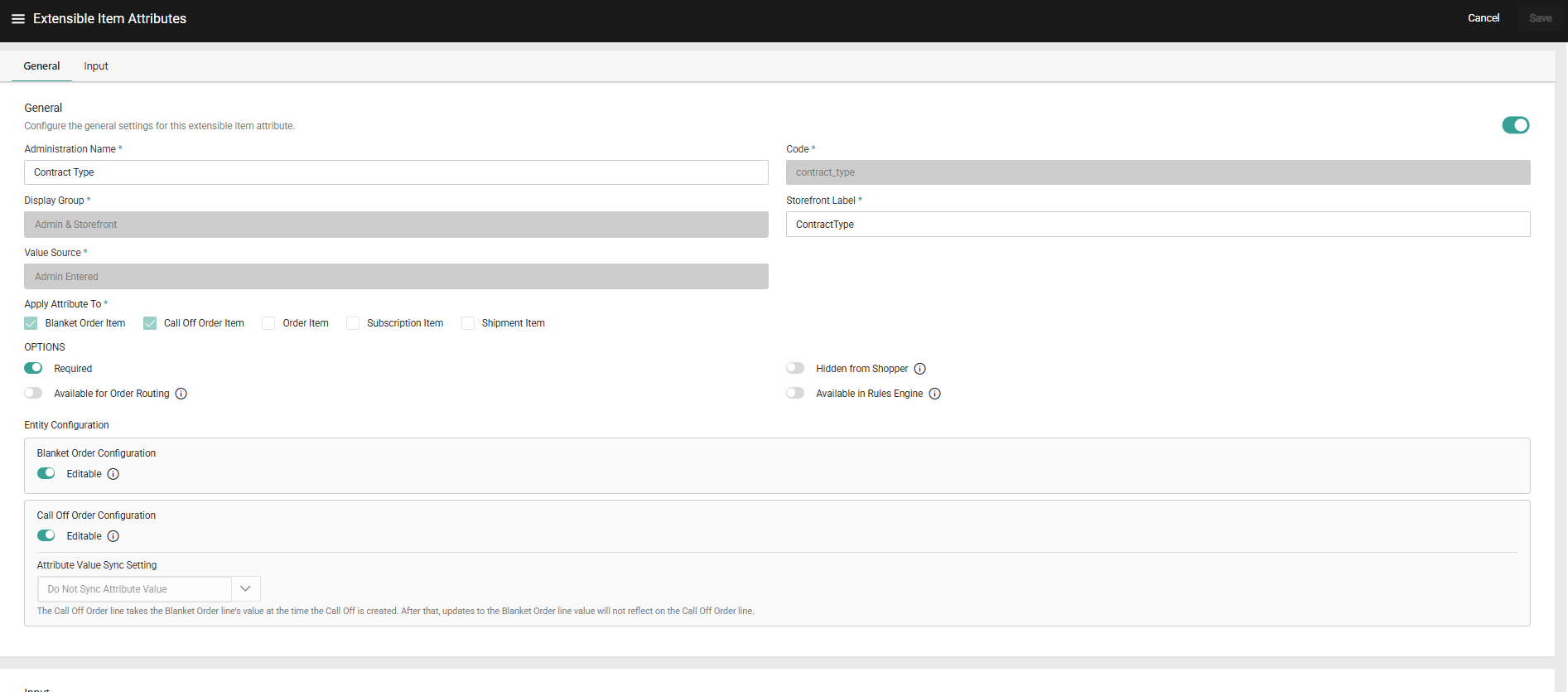
Attribute Value Sync Setting
When a line item attribute applies to both Order and Shipment, the Attribute Value Sync Setting determines how the attribute value flows from the order line item to the shipment line item. This setting is configured inside the Shipment section and cannot be changed after the attribute is saved.Sync Attribute Value
The attribute value on the shipment line item stays in sync with the order line item. Any updates to the order line item value will automatically reflect on the shipment line item. When this option is selected, the Editable setting on the Shipment section is automatically disabled, as the shipment line item value is always driven by the order line item.Do Not Sync Attribute Value
- For Shipment Line Item: The shipment line takes the order line’s value on shipment line creation. After that, updates to the order line value will not reflect on the shipment line.
- For Call-Off Order Line Item: The call-off order line takes the blanket order line’s value on call-off order line creation. After that, updates to the blanket order line value will not reflect on the call-off order line.
- For Order Line Item: The sales order line takes the call-off order line’s value on sales order line creation. After that, updates to the call-off order line value will not reflect on the order line.